Let Them Paint the Walls: What Happens When Parents Finally Stop Waging War on Mess
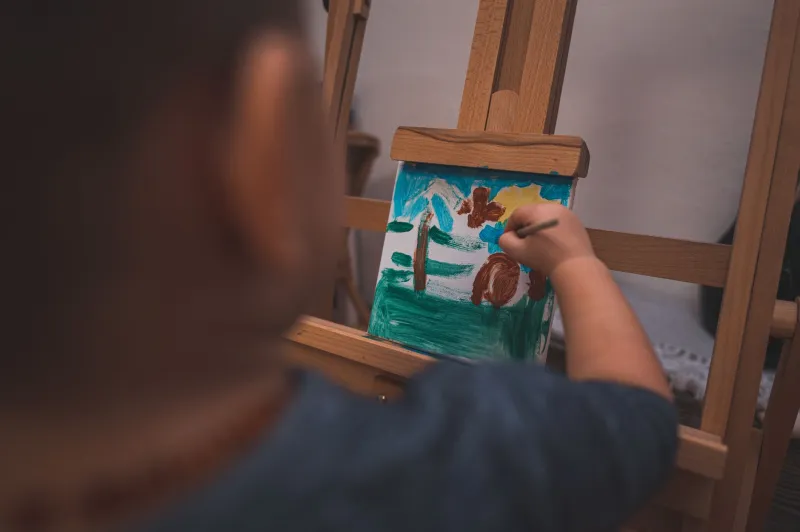
There is a specific kind of exhaustion that hits when you've just cleaned the kitchen and your four-year-old walks in with a popsicle and an expression of pure, innocent intent. You know the look. It's the look of someone who has no idea they're about to ruin your afternoon.
For a lot of parents, the response to that look has become automatic — a tightening, a brace, a redirect. Not on the couch. Not on that shirt. Not near the dog. The house becomes a series of negotiations between what children naturally are (chaotic, sticky, magnificently unconcerned with surfaces) and what we've decided home should look like.
And somewhere in the middle of all that negotiating, something quietly gets lost.
The Instagram Family Ideal and What It's Actually Costing Us
It would be unfair to blame social media entirely — perfectionism in parenting predates the algorithm. But the relentless scroll of coordinated outfits, spotless playrooms, and artfully arranged snack plates has done something insidious: it's made the ordinary chaos of raising kids feel like a personal failure.
The muddy boots by the door, the crayon that somehow got on the wall, the dinner that ended up more on the table than in anyone's mouth — these used to just be Tuesday. Now they feel like evidence of something.
Clinical psychologists have been raising flags about this for years. The pressure to perform curated family life — not just for social media, but internally, in the standards we hold ourselves to in private — is linked to elevated parental anxiety, lower satisfaction with the parenting experience, and, critically, a kind of emotional distance from our kids that none of us signed up for.
When you're managing aesthetics, you're not fully present. You can't be. You're somewhere else, calculating the damage.
What the Research Actually Says About Mess and Kids
Here's where it gets interesting: the environments that look the most "put together" are often not the ones where kids are thriving the most.
Developmental psychologists have long understood that unstructured, messy play — the kind that involves dirt, water, paint, building materials, and the freedom to make genuine disasters — is foundational to cognitive and emotional development. It builds problem-solving skills, frustration tolerance, creativity, and the ability to take risks. These are not small things. These are the building blocks of functional adults.
A landmark study out of the University of Minnesota found that children who experienced more autonomy in play — including the freedom to make messes — showed stronger executive function skills by the time they reached school age. Executive function: that's planning, focus, self-regulation. The stuff that determines how kids handle hard things.
And the mess isn't just good for kids. Dr. Stuart Brown, founder of the National Institute for Play, has spent decades making the case that playful, unstructured environments reduce stress hormones in everyone in the household — including the adults. The uptight house, it turns out, is not the calm house.
The Moment Parents Describe When They Let Go
Talk to parents who've consciously relaxed their grip on household order, and a lot of them describe a similar turning point. Not a dramatic conversion — just a moment where the cost of the fight stopped making sense.
For one mom in Nashville, it was a Saturday afternoon when she realized she'd spent the entire morning redirecting her kids instead of being with them. "I was managing the house, not my children," she says. "And I looked at my daughter's face and she just looked... managed. Not loved. Managed."
For a dad in Colorado, it was a camping trip where, without the house to protect, he was suddenly free to just be with his sons. "They were filthy the entire weekend and I didn't say a word about it. And it was the best three days we'd had in months. I came home and thought — why is it different here?"
The answer, for both of them, was the same: at home, the house was a third party in every interaction. A standard to be upheld. A thing that needed protecting from the children who lived in it.
What "Embracing the Mess" Actually Looks Like
This is not an argument for living in squalor or abandoning all standards. That's the false binary that keeps a lot of parents from making any shift at all — the fear that letting go of perfect means descending into chaos.
What it actually looks like, in practice, is much more modest:
Designating zones of freedom. Many parents find that having one room — a playroom, a basement, a corner of the yard — where anything goes creates a pressure valve for the whole house. The kids have a space that's genuinely theirs. The rest of the house stays manageable without constant negotiation.
Letting kids participate in the mess and the cleanup. Research consistently shows that kids who help clean up their messes — on their own timeline, with their own (imperfect) effort — develop more responsibility than kids who are simply redirected away from disorder. The mess becomes a learning loop instead of a conflict.
Dropping the performance standard. This is the harder one. It means letting the house look lived-in when people come over. It means not staging the family photo. It means letting your kid wear the mismatched outfit they chose themselves, the one that makes no sense, because the autonomy is worth more than the aesthetic.
Choosing presence over protection. When the choice is between getting down on the floor with your kid and protecting the rug, the rug is almost always the wrong choice. Rugs can be cleaned. Childhood moves in one direction.
The Chaos Is the Point
There's a version of parenting that looks really good from the outside and feels hollow from the inside. The house is always ready for guests. The kids are always clean in photos. The snacks are always cut into shapes. And the parents are exhausted and slightly disconnected from the actual humans they're raising.
And then there's the other version. The one with handprints on the sliding glass door that you keep meaning to clean but kind of love. The one where dinner is loud and someone always spills something and the dog is definitely not supposed to be under the table but he's under the table. The one where the kids know, in their bones, that this house is theirs — that they are welcome here in their full, messy, magnificent reality.
The research points toward the second house. The kids who grow up there tend to be more resilient, more creative, more securely attached to the people who raised them.
The crayon on the wall isn't evidence of failure. Sometimes it's evidence that a child felt free enough to make their mark.
Maybe leave it a little longer before you paint over it.